
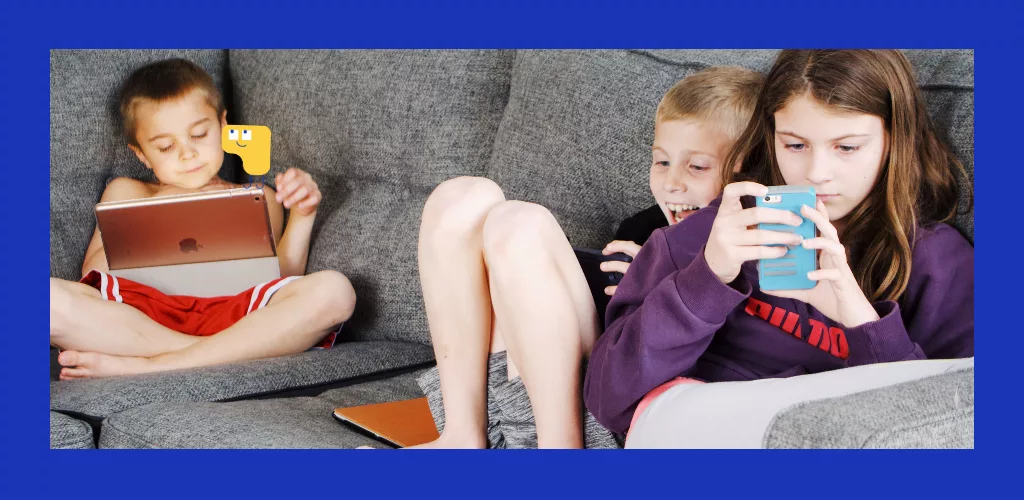
You touch your phone 221 times a day. You spend 3h30 on it every day. You check it before you even get out of bed. And yet... you worry about your children glued to their screens. Does this contradiction speak to you? You're not alone. Welcome to the infernal circle of parental guilt over screens.
Today, the issue of screens has become one of the greatest educational challenges of our time. Between one anxiety-inducing report after another, contradictory injunctions and our own addiction to digital technology, it's hard to know which way to turn. The result: we feel guilty. A lot of it. And this guilt, far from helping us, paralyzes us.
Why do we feel so guilty when it comes to our children's screens?
An unattainable standard
Parents' guilt over their children's use of screens is enormous these days. And with good reason: the standard of what we call "good digital parenting" is set far too high. We're expected to be available all the time, to have time and expertise on every application, and to offer our children plenty of desirable alternatives to screens.
Let's be honest: when you come home from work tired, having to prepare dinner, manage homework and think about everything else... that ideal digital parenthood that demands so much availability and energy, you clearly tell yourself that you'll never be up to the task.
A confrontational and solitary face-off
This question of screens is often experienced as a "confrontational and solitary face-off" within each family. We feel alone, isolated, and this isolation is directly linked to the feeling of never doing enough. The result: even more guilt.
We really need to "get out of this guilt, this isolation" and put the collective, the common back together on these issues. Because we're not going to get through this alone. We need to talk about it, to feel helped, to turn to associations, to the school, to other parents who are also struggling.
The mirror effect: our own contradictions
And let's face it: we adults aren't exactly exemplary. Isn't this ambivalence we reproach our children with just a mirror image of adults?
"We're always torn between the desire to protect our children and the desire to set an example without always knowing how to do it.
Figures that hurt (and that concern us too)
Let's talk numbers. Because the data are indisputable:
Adults and their screens
-
221 times a day is the average number of times an adult touches his or her smartphone. That's about once every 4 minutes.
-
3h30 a day that's how much time we spend on our screens every day.
-
80% of French people consult their smartphone as soon as they wake up (and no, it's not to kiss their spouse).
-
68% of parents admit to being distracted by their phone when talking to their children.
-
65% of French people use their smartphone... in the bathroom.
We can't even have five minutes of disconnection anymore. The smartphone has become our adult comforter.
Technoconferencing: when your phone destroys your relationship
This permanent distraction caused by our phone even has a name: techno-conferencing. It's the interference of technology in our relationships. And our children are noticing: 54% of them say their parents check their phones too often.
As this observation perfectly explains: "The question of techno-conferencing, i.e. the way in which ultimately a notification will divert our attention from this ability to pay attention to each other."
When we're glued to our screens, our children lose their bearings. It's a question of how much we care for each other.
You're the first generation of parents with children connected to social networks.
Here's an essential truth we all too often forget: you're the first generation of parents with children connected to social networks.. It's normal to feel your way, to adjust and to have doubts.
Our parents never had to deal with this. They've never had to wonder at what age to give a smartphone, how to accompany a teenager on TikTok, or how to react to a child who spends hours on social networks.
We learn as our children learn. We experiment. We make mistakes. We readjust. And it's OK.
How do you get rid of guilt?
Make a small inventory without setting the bar too high
The first step is introspection: taking stock, a little inventory of how you can act. But be careful: "don't set the bar too high on what you can do"..
There's something we need to do, to look at ourselves and see what we can do, realistically and pragmatically. And then there's something to build with our children too, to get rid of this guilt.
Putting the collective back together
"You're not alone" That's the first piece of advice you need to stop feeling guilty. You need to talk to friends, create support circles around these issues. It really helps to break the isolation.
Acknowledging vulnerability is not a flaw. It's not a fragility that's going to expose us either. Sometimes, the fact of feeling supported by friends, parents at school, on these questions, it feels really good to just say: "It's complicated, isn't it?"
As this valuable advice from my friend Amélia Matar reminds us: "parenting alone is frankly mission impossible. In fact, when you look at the history of humanity, we've never been parents on our own, we've always been parents in a community. So let's recreate that collective."
Articulating intimate and collective dimensions
We really need to combine this intimate and collective dimension, because we can't cope on our own. We need to turn to associations that can help us put into words what's going on, but also help us educate our children. We also need to turn to the school.
There's an almost political dimension (in the original sense of the word) in thinking about this issue collectively.
From guilt to education
The problem isn't the screens
Here's a soothing truth: the problem isn't screens as such. It's the attention economy.
When we talk about the deleterious effects of digital technology, we're really talking about those applications and platforms that set up mechanisms to capture our attention and that of our children.
Technology is what we make of it. And if we're to succeed in doing something good with it, we're all going to have to educate ourselves on these subjects, from 0 to 77 years old.
Developing techno-discernment
This is no longer a time for guilt or absolute prohibition. We need to develop what we call techno-discernment in our uses.
This involves :
-
Understanding how these platforms work
-
Questioning our own uses
-
Talking to our kids about what they do online
-
Help them develop critical thinking skills
Being curious without judging
What's really lacking today is adults' curiosity about what children are doing on screens. We're in a bit of an "old fart" mode, rejecting everything out of hand.
But behind the screens, there's also creativity, ultra-interesting people, knowledge, the ability to connect with others.
We need to restore dialogue. Take an interest in what our children watch: who they follow, what they like, why. Ask them to show us their favorite TikToks, without judging.
Practical advice to stop feeling guilty
1. Verbalize what you do on your phone
A very practical tip: when you pick up your phone in front of your children, tell them what you're doing on it.
It lets you see for yourself that sometimes your uses may not be very appropriate at the time, and that you're actually doing some techno-conferencing. But on the other hand, when you need to do a search or send an important message, it lets them see that you're not turning away from them to go scrolling, but that you're really doing something in a conscious and enlightened way.
2. Be consistent (without being perfect)
It's not a question of putting enormous pressure on yourself by aiming for zero screens. It's about being consistent with what you're trying to instill in your family in terms of rules, and being consistent with that yourself.
If you ask your teen not to be on the phone at dinner, do the same. If you ask your teen not to have a phone in the bedroom at night, do the same.
It's not easy enough, but it's the best example to set for children.
3. Preserves moments of attention
Try to preserve moments of attention, finally pacts where the whole family puts screens aside. Moments when we are fully present to each other.
No double screens: if we're watching a film together, we put the phone away. No cell phones at the table. These simple rules, applied by all, create a clear, credible framework.
4. Take a genuine interest in what they do
Instead of simply limiting screen time, focus on content. Ask them what they remembered today from their scrolls on social networks, what content, videos and content creators particularly appealed to them, why, what they learned and what they found interesting.
Try to get him to talk about content, rather than just wrapping it up in a catchword ("social networks"). Try to dig a little deeper and see what it's all about.
5. Build the rules with them
Discuss the rules together. Ask them: what do you think is fair in terms of screen time or in terms of the content you want to access? What would be good for you?
Discussing these rules together makes it easier for them to apply and understand them, and makes them more concrete in real life.
6. Multiply the looks
Don't hesitate to involve other viewpoints than your own: a doctor who talks about the impact of screens on the brain during a check-up, a teacher, an entertainer. It's a great way to get out of the role of "lazy parent who wants to take away the things we like".
Things to remember
✅ Parental guilt about screens is huge, but it doesn't solve anything
✅ We're setting the bar too high for what constitutes "good digital parenting".
✅ We're alone, isolated when it comes to these issues, but we need to work together.
✅ We adults are also addicted to our screens (221 times a day!).
✅ Techno-conferencing cuts us off from our children without us realizing it
✅ You're the first generation of parents with children connected to social networks: it's normal to feel your way around.
✅ The problem isn't screens, it's the attention economy
✅ We need to move from guilt/prohibition to education/technology.
✅ Be curious about what your kids are doing online, without judging.
✅ Build the rules with them, not against them


0 comments